
Guide 02 · Fastener Reference Guide
Tensile Strengths
Approximate tensile strength comparison of steel grades and classes.
Every metric bolt carries its strength stamped on the head: 4.6, 8.8, 10.9. It is not a model number. Once you can read it, the number tells you what the steel will do before it stretches and before it breaks.
Reading the number
The two figures are a formula, not a ranking.
- The first number is the tensile strength — how hard you can pull before the bolt breaks — in hundreds of megapascals. Class 8.8 is around 800 MPa.
- The second number is the yield point as a tenth of that tensile figure. The .8 in 8.8 means the bolt starts to permanently stretch at about 80% of its breaking strength, roughly 640 MPa.
The class number is nominal; the standards set the actual minimums at or slightly above it. Class 10.9 is a good example — nominally 1000 MPa, but ISO 898-1 requires a minimum of 1040 MPa tensile and 940 MPa yield. The comparison chart below lists the figures MEGAFIX works to.
Yield matters more than people expect. A bolt stretched past its yield point does not spring back. It has lost clamping force while still looking perfectly serviceable, which is how over-tightening quietly ruins joints that never visibly fail.
Which grade for which job
- Class 4.6 — low carbon steel, not heat treated, 400 MPa. General fabrication, brackets, gates, fencing, light equipment mounting: holding things in place rather than carrying heavy load.
- Class 8.8 — medium carbon steel, quenched and tempered. 800 MPa up to and including M16, 830 MPa above M16. The structural and mechanical workhorse, and what most trade work is built around.
- Class 10.9 — quenched and tempered alloy steel, 1040 MPa. Heavy machinery, mining equipment, hydraulic and press work, and joints designed around a specific bolt tension.
Higher is not automatically better. High grade steel is harder but less ductile, so it tolerates shock loading, misalignment and over-tension far less gracefully than 8.8. And never substitute a higher grade into a structural connection that specifies 8.8 without an engineer's approval — those connections are designed around a known bolt behaviour, not the biggest available number.
Match the nut to the bolt
A bolt is only as strong as the nut on it. Nut property classes are numbered to match under ISO 898-2: class 8 nuts for class 8.8 bolts, class 10 for 10.9. Fit a low grade nut to a high grade bolt and the nut thread strips long before the bolt reaches capacity, throwing away everything the higher grade was bought for.
This guide is here to help you understand and sanity-check a specification, not to replace one. Structural and safety-critical connections should always be designed by a qualified engineer.
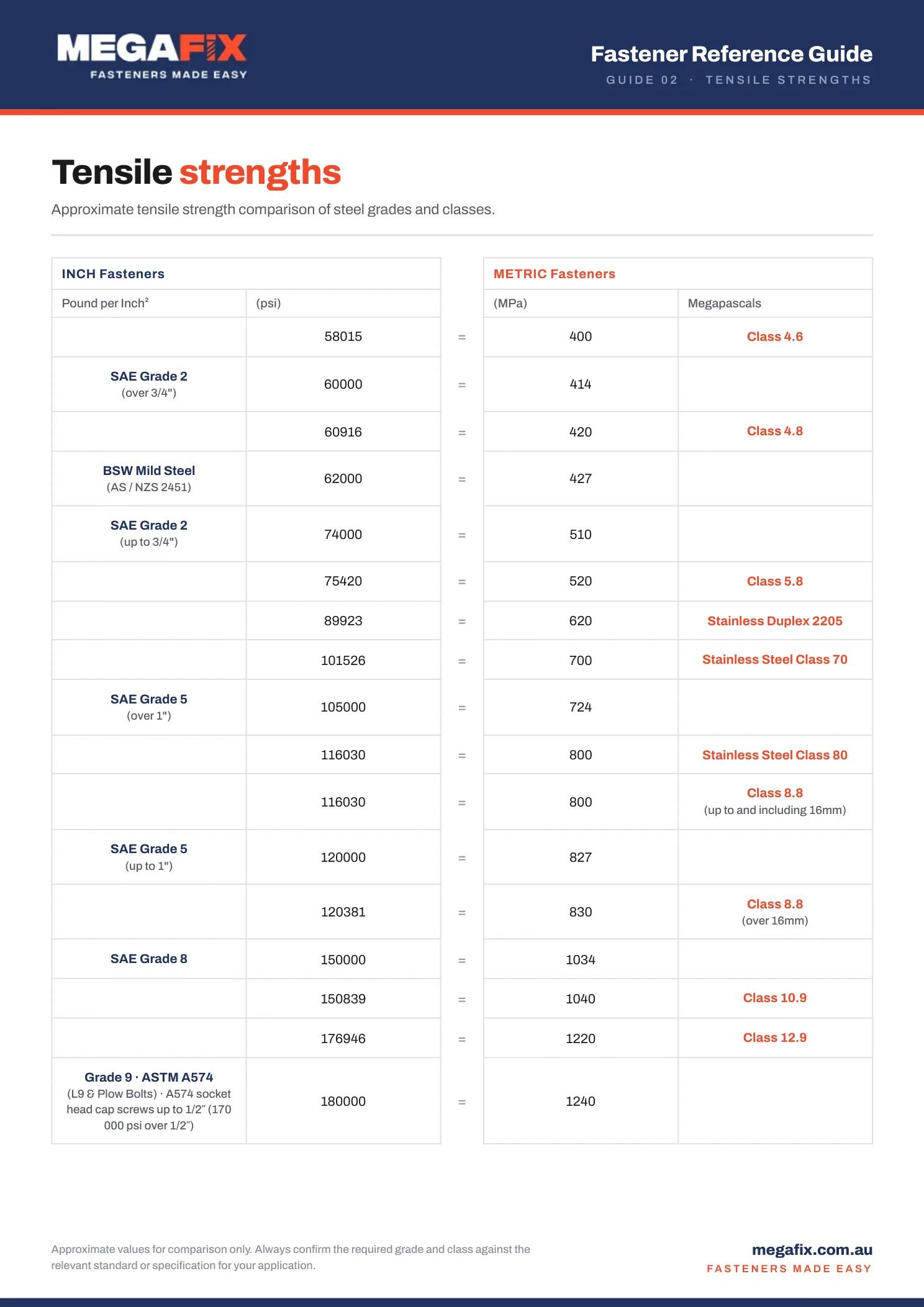
Text version — searchable and screen-reader friendly
INCH Fasteners
| Pound per Inch² | (psi) |
|---|---|
| 58015 | |
| SAE Grade 2 (over 3/4") | 60000 |
| 60916 | |
| BSW Mild Steel (AS / NZS 2451) | 62000 |
| SAE Grade 2 (up to 3/4") | 74000 |
| 75420 | |
| 89923 | |
| 101526 | |
| SAE Grade 5 (over 1") | 105000 |
| 116030 | |
| 116030 | |
| SAE Grade 5 (up to 1") | 120000 |
| 120381 | |
| SAE Grade 8 | 150000 |
| 150839 | |
| 176946 | |
| Grade 9 · ASTM A574 (L9 & Plow Bolts) · A574 socket head cap screws up to 1/2″ (170 000 psi over 1/2″) | 180000 |
METRIC Fasteners
| (MPa) | Megapascals |
|---|---|
| 400 | Class 4.6 |
| 414 | |
| 420 | Class 4.8 |
| 427 | |
| 510 | |
| 520 | Class 5.8 |
| 620 | Stainless Duplex 2205 |
| 700 | Stainless Steel Class 70 |
| 724 | |
| 800 | Stainless Steel Class 80 |
| 800 | Class 8.8 (up to and including 16mm) |
| 827 | |
| 830 | Class 8.8 (over 16mm) |
| 1034 | |
| 1040 | Class 10.9 |
| 1220 | Class 12.9 |
| 1240 |