
Guide 17 · Fastener Reference Guide
Zinc Coatings
Three ways to put zinc on steel — and why the difference matters.
In Perth conditions the coating decides how long a fastener lasts, and on high strength bolts it can decide whether the fastener is safe at all. The comparison below sets out the three zinc options; these are the points worth knowing before you choose.
Coating changes the thread
Hot dip galvanising lays down a thick coating, so nuts for galvanised bolts are tapped oversize to suit. That is why a galvanised nut spins freely on a plain bolt and a plain nut will not run onto a galvanised one. Order them as a matched pair.
Electroplating adds almost nothing to the thread, which is part of why it suits indoor fixings and general hardware — but it is thin, easily scratched through, and no substitute for galvanising outdoors.
The high strength trap
High strength steel is vulnerable to hydrogen embrittlement: hydrogen driven into the steel during processing can cause a sudden brittle failure weeks or months after installation, with no warning and nothing visible beforehand.
The hydrogen does not come from the zinc. It comes from acid pickling before coating, and from electroplating itself.
- Class 8.8 and below are routinely hot dip galvanised and perform well.
- Above class 8.8, MEGAFIX does not supply hot dip galvanised. Class 10.9 galvanised bolts have a documented history of embrittlement failures, and AS 1214 calls for baking where high strength fasteners are acid cleaned.
- Electroplated high strength fasteners must be baked after plating to drive the hydrogen out.
If you need both very high strength and serious corrosion protection, talk to us before ordering rather than after. There are ways to achieve it, and the wrong combination is genuinely dangerous.
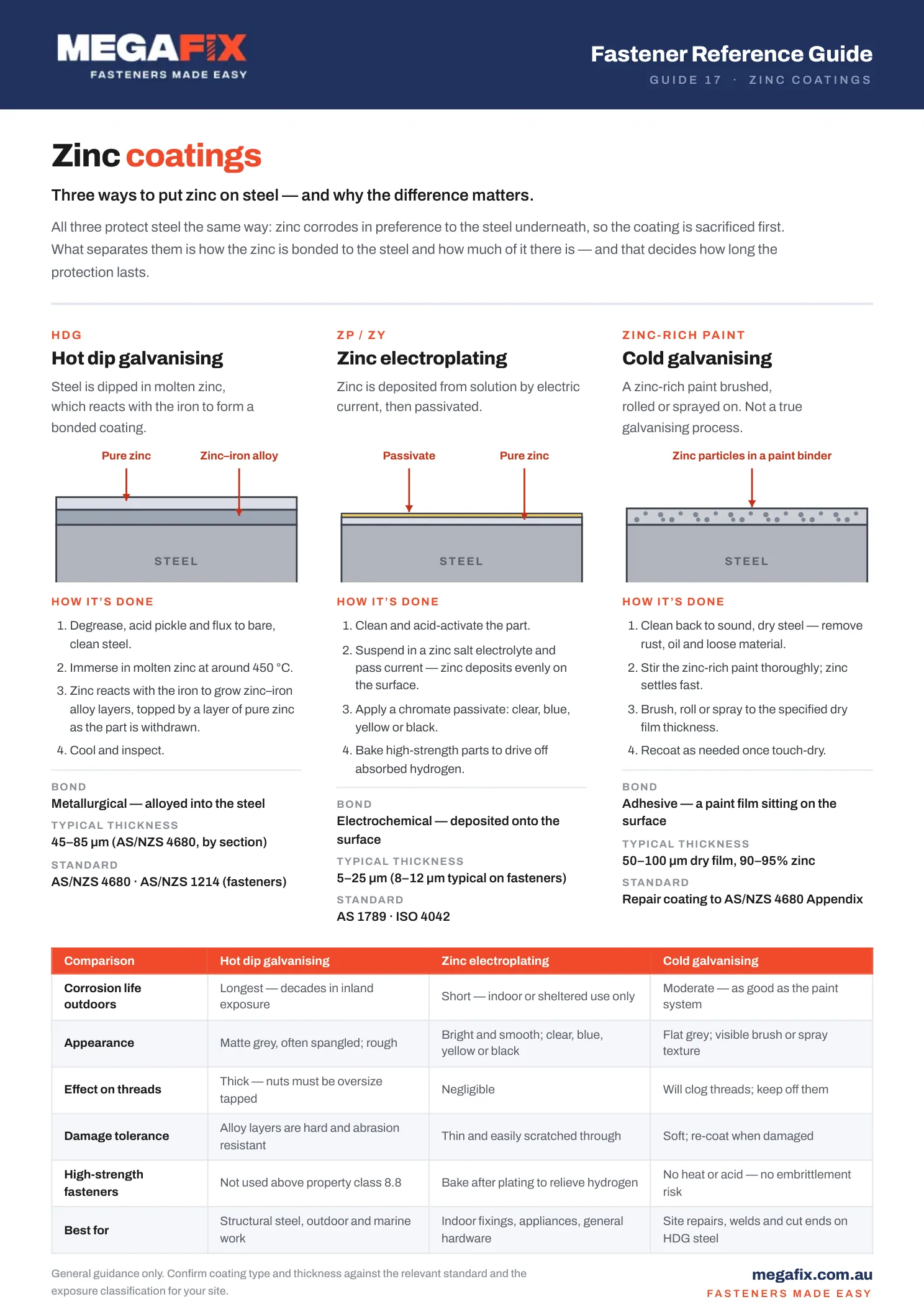
Text version — searchable and screen-reader friendly
AS/NZS 4680 · AS/NZS 1214 (fasteners) 5–25 µm (8–12 µm typical on fasteners) Repair coating to AS/NZS 4680 Appendix AS 1789 · ISO 4042
| Comparison | Hot dip galvanising | Zinc electroplating | Cold galvanising |
|---|---|---|---|
| Corrosion life outdoors | Longest — decades in inland exposure | Short — indoor or sheltered use only | Moderate — as good as the paint system |
| Appearance | Matte grey, often spangled; rough | Bright and smooth; clear, blue, yellow or black | Flat grey; visible brush or spray texture |
| Efef ct on threads | Thick — nuts must be oversize tapped | Negligible | Will clog threads; keep off them |
| Damage tolerance | Alloy layers are hard and abrasion resistant | Thin and easily scratched through | Soft; re-coat when damaged |
| High-strength fasteners | Not used above property class 8.8 | Bake after plating to relieve hydrogen | No heat or acid — no embrittlement risk |
| Best for | Structural steel, outdoor and marine work | Indoor fixings, appliances, general hardware | Site repairs, welds and cut ends on HDG steel |